“the goose-step”
The Killer“the goose-step” is both a slogan and a prescribed group movement in Mother Peep’s political rally: first announced as a means of disciplining intellectuals, it becomes a chant taken up by the crowd and a test of what the promised freedom to criticize actually permits. The phrase’s significance lies in that progression. A performance presented as collective enthusiasm turns dissent into another feature of the performance, while the stage action reveals the violence beneath its festive language.
From threat to rallying cry
Mother Peep first directs the phrase at intellectuals, declaring, “We'll make them do the goose-step! Long live the geese!” The language joins compulsion to celebration: the intellectuals are not invited to march but made to do so, while the cheer for the geese recasts their political subordination as a cause for applause. The expression therefore enters not as a neutral description of movement but as an order embedded in a public program.
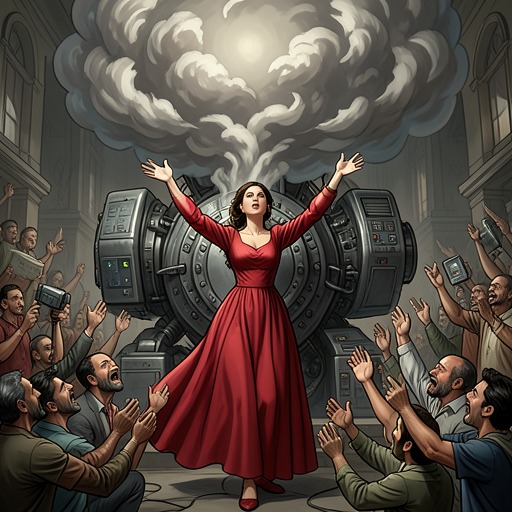
The slogan soon becomes participatory. Mother Peep calls, “Let's all do the goose-step!” and a voice in the crowd answers, “The goose-step, the goose-step!” The shift from “them” to “all” makes the movement sound universal, but the surrounding sequence has already established its coercive premise. The crowd’s repetition supplies the appearance of consent; the earlier threat remains audible beneath it. The rhythm of the call and response makes political belonging something performed together, in words as well as in marching.
The limit of permitted criticism
A man interrupts the rally to ask whether people will be free to criticize. He repeats the question after the crowd has begun chanting, bringing the promise of liberty into direct contact with the demand for conformity. Mother Peep answers, “Everyone will be free to say if the goose-step's not well done!” The reply allows criticism only as an assessment of how successfully the prescribed movement is performed. It does not offer the freedom to refuse the march or challenge the political order that requires it.
The line turns the question inside out. Criticism appears to be permitted, yet its object has been narrowed to the quality of obedience. The answer also keeps the rally’s own vocabulary in circulation: even dissent must speak about the goose-step, and so remains inside the spectacle it might otherwise oppose. The man’s repeated question registers the discrepancy between the general promise of freedom and the tightly restricted example Mother Peep gives in response.
Chant, spectacle, and violence
The rally is not presented as speech alone. As the crowd chants, rhythmic marching is heard; meanwhile, an Old Man escapes with a briefcase, followed by Bérenger, while Édouard turns back, lies on a bench, and coughs. These simultaneous actions place the political performance beside individual movements that do not join it: escape, pursuit, withdrawal, and illness. The chant occupies the public soundscape, but it does not make every person onstage part of a single, willing collective.
The scene later converts the promise of free discussion into physical force. Mother Peep produces a huge briefcase, calls for “a free discussion,” and hits the man over the head with it. She then summons her geese and offers them pasture. The ensuing struggle is obscured amid cries of “Up Mother Peep! Down with the drunk!” When Mother Peep’s head appears alone, she announces, “My geese have liquidated him. But only physically.” The final qualification makes the rally’s language of participation especially bitter: the crowd’s political fiction can deny the consequence of the violence even as the stage has just shown a man overwhelmed in the struggle.
A repeated theatrical logic
The play’s directions frame this episode as Punch-and-Judy-style spectacle, a form that makes the visible clash and its noisy reversals part of the political argument. An earlier scene is likewise directed to be played like a tragic Punch and Judy show; the later direction calls for the same style as Mother Peep’s struggle reaches its hideous conclusion. The goose-step thus belongs to a theatrical world in which political authority is displayed through gestures, cries, and staged submission, while brutality breaks through the display.
Other formal contrasts sharpen, rather than repeat, the slogan’s meaning. Duncan’s address to soldiers, dead and living, promises lasting memory while also sending survivors back to earn their bread under their lords and masters. In a separate solemn ceremony, Duncan mounts the throne and is given the scepter with which he is to touch the sick. At the end of the play, Macol demands silence before announcing that he has overcome the tyrant; Macbett’s head is then brought on a pike. These scenes do not use the goose-step, but they likewise place authoritative words beside visible political arrangements or consequences. Against that broader pattern, Mother Peep’s apparently inclusive chant is especially revealing: a crowd can be invited to speak and move together while the permitted speech, the required movement, and the force behind them remain controlled.